Thursday, November 19, 2009

These Dead Shall Not Have Died in Vain – Lincoln Delivers the Gettysburg Address


On November 19, 1863, Abraham Lincoln delivered one of the most famous speeches in American history. Lincoln was invited to attend the consecration of a cemetery for the Union war dead. For the occasion, he was asked to provide a “few appropriate remarks,” by David Wills, the man charged by the Pennsylvania governor to clean up the aftermath of the battle of Gettysburg.
Wills also asked Edward Everett, a famous orator, to offer remarks at the ceremony. Famously, Everett went on for over two hours before Lincoln spoke. After Everett finally retired, Lincoln rose and delivered what many considered at the time to be an all too brief speech. What is enduring about that ceremony are not the two hours worth of oratory provided by Everett, which have now been forgotten. Instead, generations of Americans have honored how much Lincoln was able to say about that moment in our nation’s history with so few words. First, he honored the dead who had given their lives in the civil war. Beyond that, he also hinted at what his vision of a post- war America might be like, calling for a “new birth of freedom.”
Lincoln served as his own speechwriter. My esteem for him as president only grows when I think that he not only handled the incredible difficulty of governing during the war with grace, but still managed to write words that make the hairs on the back of my neck stand up one hundred and forty-six years later. I always think the power of great speeches is evident when we hear them read aloud, so I have attached a reading of the Gettysburg Address.


Check out an online exhibit on the Gettysburg Address at the
Library of Congress.

[Images via
Library of Congress]


Tricky Dicky Might Not Be So Tricky.....New Forensic Technology Might Unlock Missing 18 1/2 Minutes on the Watergate Tapes


Today's New York Times has an article about a forensic team that has been hired by the National Archives and Library of Congress to examine notes taken by Nixon's chief of staff H. R. Haldeman during a meeting with Nixon in the White House on June 20, 1972. This meeting occurred only three days after Nixon campaign workers were arrested for breaking into the Democratic National Committee offices at the Watergate complex. Their conversation was erased from the Watergate Tapes before they were surrendered by Nixon to the special prosecutor. Haldeman's notes are believed to be the only surviving record of the meeting. The forensic team will study the notes to see if anything was erased that might have been damaging to the president. I will be curious to read their findings.

Check out the NY Times article here.

[Image via AOL]


Wednesday, November 18, 2009

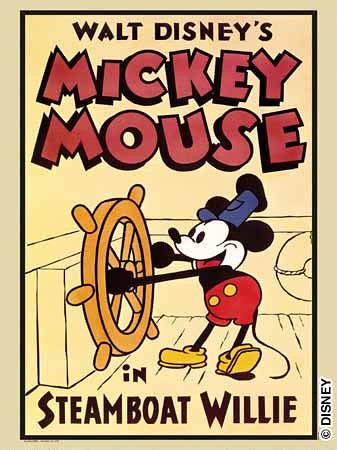
Steamboat Willie!


On November 18, 1928, Steamboat Willie featuring Mickey Mouse debuted at New York’s 79th Street Theater. The film was one of the earliest cartoons to feature post -production sound. The title Steamboat Willie is a parody of the Buster Keaton film Steamboat Bill, Jr. Supposedly, Steamboat Willie was played ahead of a film called Gang War when it debuted at the 79th Street Theater. The Disney film was an instant success while Gang War has been lost to history. Anyone know anything about this film?
In the years since its debut, Steamboat Willie has met with some censorship requests due to scenes which show cruelty to animals. (Watch for yourself here and tell me what you think). In some scenes, Mickey Mouse swings a cat over his head and later plays a pig and her young like a xylophone. Despite these scenes, the film has been selected for preservation by the National Film Registry, which is a part of the Library of Congress.
Follow the link above to watch the film in its entirety. (The film has been the subject of major copyright disputes, and I don’t want to mess with Disney)


[Image via
flickr]

Sunday, November 15, 2009

Love Me Tender - Elvis Presley Makes His Movie Debut


On November 15, 1956, Elvis Presley made his movie debut in Love Me Tender. Elvis starred as Clint Reno, a man who stays home from the Civil War to take care of his mother. When his brothers return from the war after fighting for the confederacy, they discover that Clint has married one of their girlfriends. This creates some awkwardness as we all might imagine. Added to this awkwardness is the fact that Clint’s brothers rob a train on their way home from the war, and so they become fugitives from the law. How does Elvis deal with this? Well, from the looks of the trailer below, with singing and hip shaking. Enjoy this trailer which shows Elvis’ first foray into film.

Elvis would go on to act in 31 total films. Some have criticized his movies as being a distraction from his music career, which made it easier for him to be marginalized in 1960’s. However, I think it’s important to note that he made it acceptable for other artists after him to branch out into film as another avenue in which to promote their music. Elvis made Love Me Tender in 1956 which helped promote his single of the same name and others songs from the film. Similarly, the Beatles made A Hard Day’s Night in 1964, which helped promote their album of the same name. What’s interesting is that the Beatles made a film in which they starred as themselves parodying their own fame. Elvis entered the film world by trying to disappear into a B grade period film – while maintaining his signature hairdo and wiggle. I’ve never seen this movie but now I would be curious to watch it just to see how it all works (or if it works at all).

[Image via streamingoldies]


Monday, November 9, 2009

Can You Tell Me How to Get to Sesame Street? Happy 40th Anniversary Sesame Street!


Today marks the 40th Anniversary of one of the greatest streets in the United States – Sesame Street. Generations of kids (myself included) have learned to read and count on Sesame Street. We all grew up with our favorite residents and tuned in each day to see what they were up to, not realizing how much we were learning at the same time. Who were your favorite characters?

When Sesame Street first aired on November 10, 1969 it was met with critical praise from the start. The show used Jim Henson’s muppets, along with animation and live actors to capture the attention of children long enough to teach them something. Not only did the show address early education skills like reading and writing, it also tackled a myriad of other skills and topics from how to cross the street safely to understanding different emotions. Sesame Street also covered events in American history and the idea of democracy with great humor. Below are some clips from Sesame Street’s long history. The final clips show the Street’s depiction of events in American history. Here’s to another 40 years on Sesame Street!

Here is Big Bird from Sesame Street’s first season in 1969

Cookie Monster singing about something we both love…cookies

Sesame Street also tackled American history…as only they could

Besides teaching Kids of all ages about reading and writing, Sesame Street also taught kids about Democracy. Watch as the muppets teach kids about voting.

What would a series of Sesame Street clips be without a glimpse of the most famous muppet of them all- Kermit the Frog. Here is Kermit reporting from the scene of the Boston Tea Party (where he helps clear up some confusion).

[Image via applescoop]

Monday, November 2, 2009

"I have to worry because I could be defeated" - President Kennedy on the 1960 Presidential Election


Tonight on NBC Nightly News, Brian Williams introduced a never before heard audio clip of President Kennedy in the oval office discussing a possible coup in Vietnam just as United States involvement in the war was escalating. I wasn’t able to find that clip to share, but I did find another Kennedy clip which is more appropriate to share on the eve of elections across the country. On January 5, 1960, then Senator Kennedy and his wife attended a dinner party at the home of friends. After dinner, the host pulled out a tape recorder and asked Kennedy if they could talk about his entry into politics, his own feelings about the 1960 presidential election, and his health. As a result, we have this gem of a recording, which shows Kennedy as a vulnerable candidate unsure of his chances in the presidential election. He even worries how he will start over at the age of 45 should he lose (granted he had a trust fund, but everyone still needs a purpose). Enjoy this audio clip! If you listen closely, you can even hear Kennedy clip his cigar.

Happy almost election day everyone! Get out and vote!

[Image via Independent]

Sunday, November 1, 2009

Tramps Like Us, Baby We Were Born to Runnnnnn – “Born to Run” hits #23 on the charts.

Today in 1975, Bruce Springsteen’s anthem “Born to Run” hit #23 on the charts. Bruce and his infamous E Street Band released the album of the same name on September 6th, and it quickly earned rave reviews. On October 27th, Springsteen appeared simultaneously on the covers of both Time and Newsweek reflecting the commercial and critical success of his latest album, which rocketed to the #3 position on the album chart. Each song on the album was meticulously crafted to shape the narrative of the album as a whole. Born to Run was full of emotions that would come to define Springsteen’s career including desperation, elation, and disillusionment. Springsteen is considered one of the great American songwriters and he frequently explores the meaning of American life, including the idea of the American dream. No where is this more evident than in the lyrics of “Born to Run” when he seems to speak for a generation, “In the day we sweat it out on the streets of a runaway American dream.”

Read more about Bruce Springsteen at the Rock and Roll Hall of Fame.

Enjoy this classic performance of “Born to Run” from 1975.

[Image via Rock107]