An interesting articleon the diplomatic roots of Japan’s attack on Pearl Harbor in today's NY Times. Specifically, it examines President Teddy Roosevelt’s conduct during the Russo-Japanese War and how it influenced Japan's attack on Pearl Harbor on December 7, 1941. The article is written by the son of one of the men who famously raised the American flag at Iwo Jima. What do you think?
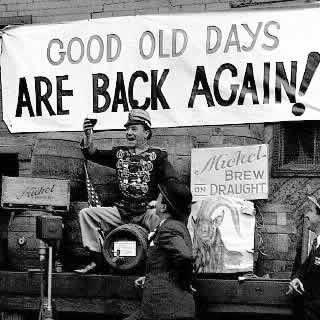
Due to the devoted efforts of the Women’s Christian Temperance Union and other groups, prohibition became a reality in 1919 with the passage of the 18th amendment to the Constitution. However, the twelve years of prohibition merely drove the production and consumption of alcohol underground, allowing organized crime to flourish. Crime was on the rise and the government had to struggle to reign it in. All the advocates of prohibition never saw that coming. The women’s groups that had once worked to end the sale of alcohol eventually reconsidered and formed groups that called for the amendment’s repeal. Their efforts carried greater weight as they had gained the right to vote in the years since the passage of prohibition. When Franklin Delano Roosevelt ran for president on the Democratic ticket in 1932, he ran on a platform that called for the repeal of prohibition. Beginning in 1933, the states began to ratify the 21st amendment which repealed the 18th amendment. The amendment was fully ratified on December 5, 1933. Check out this newsreel from 1933 which boasts that the repeal of prohibition will create new jobs, a particularly enticing idea during the Great Depression (and now).
This is not a date that I think of often, but there is a group out there looking to make December 5th, or Repeal Day, a national holiday. You can check out their site and take a look at their reasoning here.
The Morgan Library and Museum in Manhattan normally exhibits a page from Charles Dickens' manuscript of "A Christmas Carol" every year around this time. This year, they allowed a NY Times photographer to photograph every page of the manuscript in order to make it available online at the NY Times' website. Check out the manuscript for yourself here. You can see the changes Dickens' made to his manuscript, which included cutting a reference to Shakespeare's Hamlet.
On December 2, 1954, Senator Joseph McCarthy of Wisconsin was condemned by the Senate for "conduct that tends to bring the Senate into dishonor and disrepute." Senator McCarthy had made a name for himself by arguing that there were communists within the State department and various branches of the federal government. On February 9, 1950, he gave a speech to the Republican Women’s Club of Wheeling, West Virginia in which he held up a piece of paper and claimed it contained a list of known Communists working for the State Department. No audio recording survived of this meeting, so there is some dispute as to whether he said the list had 205 or 57 names. Either way, the press picked up the story and his “Wheeling speech” helped to propel him to greater fame.
While a member of the senate, McCarthy led committee investigations trying to rout out communism within the government. For the most part, he ended up isolating himself from the other senators (including those in his own party) and not providing much evidence for his claims. While the public may have entertained some of his claims out of fear, public opinion began to turn against him in 1954. The Journalist Edward R. Murrow ran two programs that were very critical of McCarthy and his message.In the conclusion of the first program, Murrow offered a strong rebuke to McCarthy and McCarthyism:
His primary achievement has been in confusing the public mind, as between the internal and the external threats of Communism. We must not confuse dissent with disloyalty. We must remember always that accusation is not proof and that conviction depends upon evidence and due process of law. We will not walk in fear, one of another. We will not be driven by fear into an age of unreason, if we dig deep in our history and our doctrine, and remember that we are not descended from fearful men.
The Senate also began investigating McCarthy and called some of his actions into question. In the Army-McCarthy hearings, the Senate investigated to see whether McCarthy and his chief counsel, Roy Cohn, had pressured the army to favor a friend of Cohn’s serving as a private. In the course of the hearings, McCarthy had a famous exchange with Joseph Nye Welch, the army’s chief legal representative. Welch challenged Cohn to provide a list of names of communist sympathizers in defense plants “before the sun goes down.” Before Cohn could answer, McCarthy stepped in and told Welch if he was so concerned about the identities of those aiding the communist party, then he should check his own firm. He then accused Fred Fisher, a man in Welch’s firm of being a member of the National Lawyers Guild, which McCarthy said was sympathetic to communists. This led Welch to make an impassioned defense of Fisher and a strong rebuke of McCarthy asking, “have you no decency sir?”. The video of the exchange is posted below (cut into two parts).
Public opinion continued to turn against McCarthy and the Senate voted to condemn him on December 2, 1954, which effectively ended his political career. President Eisenhower was pleased to see the demise of McCarthy, as he had been a longtime opponent of his methods. He is said to have remarked to his aides, “McCarthyism is now McCarthywasm.”
In 1987, Rosa Parks founded the Rosa & Raymond Institute for Self Development which is devoted to motivating the youth to reach their highest potential. Even though she passed away in 2005, her work lives on through her foundation and in the lives of those she has inspired.
Check out this great story reported by the Daily Mail (with great photos) of a World War II fighter plane that was pulled from Lake Michigan on December 1. The plane had been underwater since January 5, 1944, when pilot Walter Elcock crash landed in the lake during a training exercise. The 89 year old pilot was teary eyed when his grandson showed him footage of the plane when it was still underwater saying "I can remember it like it was yesterday." Now that the plane has been raised, it will be restored and exhibited.


 Posts
Posts