Monday, September 14, 2009

Take Me Out to the Ballgame…or Not - Commissioner Bud Selig Announces the Cancellation of the 1994 Baseball Season due to a Strike by Players


September 14th also marks the 15th anniversary of the cancelation of the 1994 baseball season after a strike by players. The main dispute was between Commissioner Bud Selig and the owners vs. the players. Selig and the owners wanted to impose a salary cap on the league, and the players wanted nothing of the kind. The strike lasted from August 12, 1994 to April 2, 1995. At the end of the day, Judge Sonia Santomayor (now Associate Justice of the Supreme Court) issued an injunction against the owners, which prevented the salary cap and effectively ended the strike before the start of the 1995 season.

Click here to read an interesting editorial by David Gregory on the legacy of the 1994 strike. For one thing, the Montreal Expos were the best team in baseball in 1994 before the strike, and the strike clearly denied them a shot at the World Series. Fifteen years afterward, the Expos have been reborn as the Washington Nationals. Who knows if the Expos would still exist had they been able to chase a World Series in 1994 and energize a whole new contingent of their fan base? Overall, it would be hard to calculate how much the teams and players lost in ad revenue, ticket sales and merchandise, but most of all: in the all important area of self-respect. With the start of the 1995 season, the anger felt by fans across the nation was evident as many felt that Americans lost out on their national pastime for no other reason than the shared greed of players and owners. Fans booed at season openers, and many were soured on the sport for good. Did the strike achieve anything lasting? Did it change the game for the worse? I can’t say, but I’m certainly open to opinions.

[Image via gooseradio]

Oh, Say Does that Star-Spangled Banner yet Wave? – Francis Scott Key composes the lyrics to “The Star-Spangled Banner”


On this day in 1814, Francis Scott Key composed the lyrics to “The Star- Spangled Banner.”

Francis Scott Key famously composed “The Star-Spangled Banner” after witnessing the British attack on Fort McHenry during the War of 1812. From his position, he could see the flag throughout the night through the light of the attacks. He waited until morning to see if the American flag was still flying, signifying that the Americans had maintained control of the fort through the night. When he saw that the American standard still flew proudly over the fort after dawn, he was moved to compose lyrics to be sung over a familiar air at the time in order to commemorate the occasion.

Visit the Francis Scott Key organization here for more information about Francis Scott Key and for a full transcript of the original lyrics (the lyrics originally included 4 verses, of which only the first is traditionally sung)

“The Star Spangled Banner,” was ordered played by President Woodrow Wilson in 1916 at military and naval occasions. It was not designated the national anthem by an Act of Congress until 1931.

Enjoy the U.S. Army band playing our national anthem:

The flag that flew over Fort McHenry and inspired Francis Scott Key to compose lyrics in its honor was the subject of a lengthy restoration at the Smithsonian. Now with the restoration complete, the Smithsonian has created a cool website to show it off. One feature lets you explore the flag in great detail, and explains the decals and other markings on the flag. Click here to check it out.

[Image via PublicDomainClipArt.blogspot.com]

“It is God’s way; His will be done, not ours.” President McKinley died of gunshot wounds inflicted by an assassin.


President McKinley (1843-1901) was the 25th president of the United States, and the last veteran of the American Civil War to serve as president. McKinley rose to the presidency in 1897 after a hard fought campaign against the Democratic candidate William Jennings Bryan. During the campaign, McKinley delivered speeches from his front porch to organizations ranging from traveling salesman to bicycle clubs (according to Wikipedia). Here is a clip from one of McKinley’s front porch campaign speeches.


McKinley’s first term saw the annexation of Hawaii, the Spanish-American War (1898), and the seizure of the Phillipines (leading to the Philippine- American War (1899-1902). In a campaign based largely on foreign policy issues, McKinley was re-elected in 1900.

On September 5, 1901, President McKinley and his wife visited the Pan-American Exposition in Buffalo, New York where McKinley delivered an address. The next day, McKinley stood in the Temple of Music greeting guests at the Exposition. Leon Frank Czolgosz was waiting in line holding a pistol covered by a handkerchief. At 4:07 pm, Czolgosz fired twice at the president. Doctors were able to extract one bullet, but were unable to extract the other for fear of doing greater harm to the president. The president recuperated at the home of the Exposition’s director for more than a week, and appeared to be improving. However, on September 14th, after taking his first small meal since the shooting, McKinley went into shock and rapidly deteriorated. He said “It is God’s way; His will be done, not ours,” shortly before passing away at 2:15 am as a result of gangrene around the site of his wounds.

Here is a video of McKinley’s funeral cortege. Notice the military escort and the carriages carrying McKinley's family. The footage ends with McKinley's coffin being carried into the church.


Czolgosz was tried and found guilty of murder. He was executed by electric chair at Auburn Prison on October 29, 1901.

The press coverage of Czolgosz’s trial and execution was incredible, and the public even sought out details of his death. Thomas Edison made a short fictional film showing his execution based on an eyewitness account. I have included it below, and even though it is fictional, it still may be jarring to some viewers.


Vice President Theodore Roosevelt assumed the presidency upon McKinley's death.


[Images via
Wikipedia and declarepeace.org]

Sunday, September 13, 2009

“I speak as a Woman. I speak as a United States Senator. “ – The election of Margaret Chase Smith to the U.S. Senate.


On this day in 1948, Margaret Chase Smith of Maine was elected to the U.S. Senate, becoming the first woman to have served in both houses of Congress. Margaret Chase Smith (1897-1995) was a moderate Republican and early opponent of Joseph McCarthy. On June 1, 1950, she delivered her Declaration of Conscience speech on the floor of the U.S. Senate. This earned her the nickname “Moscow Maggie” from McCarthy’s staff.

To read Margaret Chase Smith’s Declaration of Conscience speech in its entirety,
click here.

Having served in both, Margaret Chase Smith knew the different responsibilities of the House and Senate as set out in the U.S. Constitution. Test your knowledge of the legislative branch
here.

[Image via
Absolute Astronomy]

Saturday, September 12, 2009

Going to the Chapel – 56th Anniversary of Kennedy Wedding


Today marks the 56th wedding anniversary of President and Mrs. John F. Kennedy. The two were married at St. Mary’s Roman Catholic Church in Newport, RI. Here is a link to the JFK Presidential Library’s description of the ceremony and lavish reception.

Here is a newsreel of the event showing notable guests and a brief glimpse of the newly wedded Kennedys emerging from the church.


Friday, September 11, 2009

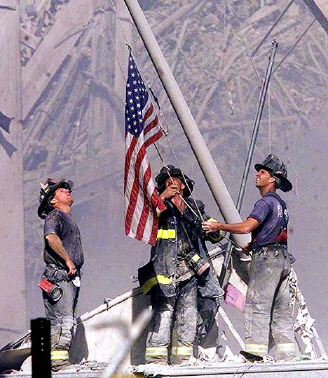
Anniversary of Terrorist Attacks of September 11, 2001


Today marks the eighth anniversary of the Sept. 11th terrorist attacks on the Twin Towers and the Pentagon. 2,752 Americans lost their lives on that day. This year, Leon Bernard Heyward’s name was added to the list of the casualties of 9/11 after he died in October as a result of exposure to dust after the collapse of the World Trade Towers. It’s hard to describe the full measure of the tragedy of that day or the myriad ways it still impacts American life today.


Thinking back, I can remember being a sophomore in high school and sitting in my American history class when the principle announced the attacks on the World Trade Tower over the loudspeaker. Our teacher told us that we were all unfortunate witnesses to a day that would live in infamy in American history. Not since the attacks on Pearl Harbor has there been a foreign attack on American soil of this size or scale. Where were you on 9/11? Are your memories of the day still vivid?

Today, let us remember those who passed and their families, along with those serving in the armed forces who were called to war as a result.

Here is a link to the New York Times’ coverage of the memorial at ground zero this morning.

For a slideshow of today’s memorial, click here.

Finally, here is a link to the September 11 Digital Archive. This archive attempts to collect, preserve, and present the history of September 11, 2001 and its aftermath. In 2003, the archive became a part of the Library of Congress. This site features witness’ accounts of the attacks and many other resources to help teach the history of this sad day in American history.

[Images via reformedpastor and smh]

Thursday, September 10, 2009

One Giant Leap for Mankind - Americans in Space and the New and Improved Hubble Telescope


This week, NASA released photographs from the newly repaired Hubble Telescope. These images are so surreal that I think they humble anyone who views them by reminding us all that we are not just players in American history, or world history, but in a universal history. Ever since human beings could look up at the night’s sky, we have wondered how we fit into a larger picture. I won’t get philosophical or scientific about this, (that can be for other blogs) but I will say that the history of space exploration is a part of American history that I often overlook.

It is hard to believe, for example, that it was only 40 years ago that the United States landed astronauts on the moon. Likewise, it has only been 28 years since the first US space shuttle flight in 1981. That said, in such a relatively short span of years, it is difficult to believe how blasé we’ve become in American culture about our own space exploration. Almost more famous than the moon landing itself are the stories of how many people watched it on TV, with some estimates placing the number of viewers at half a billion worldwide. Ask a parent, grandparent or teacher where they were the night of the moon landing, and they will probably tell you that they watched with baited breath as Neil Armstrong took his short step for man and giant leap for mankind. Comparatively, when the shuttle crew launched in May to repair the Hubble telescope, I would be safe in guessing that the amount of people who followed the story online or took notice of it in newspapers or other media outlets was dramatically less. However, many media outlets have reported on the fruits of these astronauts’ labor: which focuses on these amazing photos showing other universes, the births of stars and other cosmic wonders.

Enjoy this video featuring some of the photos obtained by the newly repaired Hubble telescope courtesy of NBC Nightly News. If you don’t have time to watch the video, then just take a step outside and look at the sky and enjoy feeling small.

Hubble ready for its close-ups

For more information about the Hubble telescope and its importance in American scientific history, click here.


For a timeline of America’s shuttle program, click here.

[Image via The Flash]