Wednesday, April 28, 2010

Twitter: The Future of History?


Recently, the Library of Congress announced that it would be accepting all of twitter’s archives for its digital collections. This has led to interesting questions about the use of Twitter by historians in the future. Slate had a great article about the myriad ways historians might use twitter in the future. Namely, food historians could use tweets about different products to track consumer product reactions. Historians could also use the trending feature on twitter to see how quickly different trends spread and how.  
 Here is a great interview with Martha Anderson, the director of the National Digital Information Infrastructure and Preservation Program at the Library of Congress. In her conversation with Phoebe Connelly, she discusses how the Library acquired the Twitter archive and how they might organize it to make it available to the public. Good news: if you have any embarrassing tweets, you have up to 6 months after posting them to delete them before they become archived by the Library of Congress. This means you John Mayer!
I think this development is a great step in the right direction. For years, historians have been worried about how we will tell the story of our generation when there are no longer any letter writers or many diarists (even if there are more of those then we think). Today’s generation seems to sharing most of its reactions, experiences and random thoughts online. The idea that we can harness the data of these social networking sites is great news to everyone worried about saving our history and a warning to the classic over-sharers who hang out online: you are leaving a bigger footprint than you may know!


[Images via Wikimedia]


Tuesday, April 27, 2010

George Washington has $300,000.00 in late fees…that’s a lot of Washington's


Last week, George Washington was in the news when it came to the attention of the New York Society Library that he had two outstanding library books.  The library loaned the two books to Washington when he was in New York serving as President (New York was the initial national capital). Washington wasn’t the only political luminary to visit the library, as Aaron Burr, Alexander Hamilton and John Hay also show up on the library’s ledger as patrons. This same ledger lists the person who took out the “Law of Nations” (a treatise on international law) and Vol. 12 of “Commons Debates” (which contained transcripts of debates in the House of Commons) as simply the “President.”  The books were due back November 2, 1789, and needless to say, they never made it. The library is hoping to get the books back for its collections, but I doubt that will happen. What do you think happened to those books?
           In other George Washington library related news, there has also been recent mention of a movement to establish a George Washington Presidential Library. In an op-ed in the Washington Post, Kathleen Parker discussed this possibility. She is a member of the group trying to make it happen, and says that the group still needs to raise $20 million to start construction.  I’m all for it, especially because it would allow scholars a place to study Washington’s contributions in a concentrated way, and possibly foster greater intellectual connections. Also, on a more common sense note, if Rutherford B. Hayes gets a presidential library, shouldn’t the founder of our country?


[Image via geniocity]


Monday, April 26, 2010

Ahab Goes to the Opera

Here is a great story about a new opera based on Melville's Moby Dick that is being mounted by the Dallas Opera. The opera will not include the book's signature opening line, "Call me Ishmael," but does draw about half of its dialogue from the book. Would you want to see an opera based on Moby Dick?

Want to read Moby Dick? Check it out for free at Project Gutenberg.

[Image wwwedu]

Thursday, April 22, 2010

Great Cold War Educational Video….Starring Marionettes


The good people over at Internet Archive (www.archive.org) posted this video on their facebook account today and I just had to share it. It is a video produced by the U.S. Civil Defense office in 1965 to educate farmers about what to do in the event of a nuclear attack…and it stars marionettes. It’s pretty priceless. Also, who knew stacks of hay could protect you from the effects of a nuclear bomb?


Happy Earth Day!


Today marks the 40th anniversary of Earth Day. Wisconsin Senator Gaylord Nelson, an environmental advocate, founded the environmentally conscious holiday in 1970. He wanted a day to unite all the grassroots environmental groups across the United States to create a grater awareness of environmental issues. The holiday got off to a rocky start in 1970, with President Nixon reluctant to acknowledge the Earth Day movement – assuming it was part of the anti-administration, anti-Vietnam movement. While Nixon and the federal government didn’t play a big role in the first Earth Day, it did establish the Environmental Protection Agency that July by special executive order with the goal of regulating and enforcing national pollution legislation.
 In the years since the first Earth Day, concern over the state of the environment has become a moral issue. While some are still content to link concerns over climate change to modern day liberalism (we are living in a post Al Gore Inconvenient Truth world after all), surely the idea that we should “clean up the mess we made” (as Walter Cronkite once said) is goal everyone can aspire to  - regardless of nation, race, religion, etc.
Has much changed in since the first Earth Day? Well, the NY Times says that Earth Day has done a 180 from its original anti-business slant to now being something of a cash cow. Below are some videos showing events from the first Earth Day. Even though the interviews and speeches by scientists and activists are from 1970, it feels like a modern day conversation about our environment. People were concerned about pollution in urban areas and beyond and how pollution and a lack of resource renewal could affect every aspect of human life. It’s pretty scary stuff when you stop and think about it. Do you think Earth Day really motivates people to think about the state of our environment? Do you think anyone will change his or her behavior/way of thinking as a result?

Here are some tips from the EPA about how to improve our relationship with the environment, including ways to save energy, recycle and use water more efficiently.   

Enjoy the coverage of the first Earth Day by CBS News with Walter Kronkite (check out how different Dan Rather looks in one of the pieces)

Happy Earth Day!


[Image via USA.gov]


Tuesday, April 20, 2010

First Detective Story Published – (No, it’s not Sherlock Holmes…)


Today marks the publication of what is arguably the first detective story. Murders in the Rue Morgue was written by Edgar Allan Poe and published on April 20, 1841. Want to give it a read? Here it is. 

[Image via macworld]


Monday, April 19, 2010

Oklahoma City Bombing – Fifteen Years Later

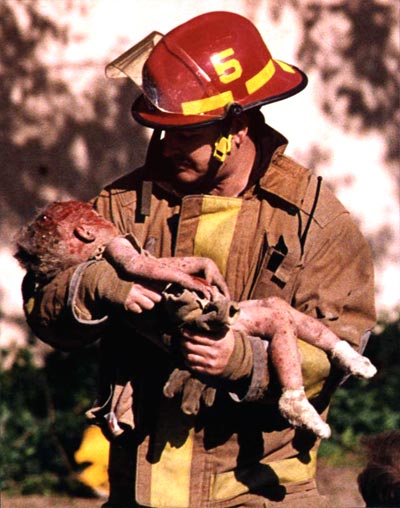
Today marks the 15th anniversary of the bombing of the Alfred P. Murrah Federal Building in Oklahoma City, Oklahoma. It’s hard to believe that fifteen years have passed since this tragic event, which, prior to 9/11, was the worse terrorist attack on American soil. The bombing took the lives of 168 Americans, including 19 children under the age of 6, and injured over 680 others. The sheer force of the blast took off a third of the building and destroyed or injured an estimated 200 surrounding buildings. Timothy McVeigh and Terry Nichols were arrested for planning and executing the bomb, for which McVeigh was executed in 2001 and Nichols sentenced to life in prison.

Bill Clinton reflects on the tragedy that occurred during his presidency in a NY Times Op-Ed today. In it he alludes to the bombers’ supposed motivations, which stemmed from a strong hatred of government. When Timothy McVeigh was pulled over by police 90 minutes after the bombing for driving a car without a license plate, he was wearing a shirt with two phrases on it: the first was the state motto of Virginia, “Sic semper tyrannis” (or “To All Tyrants” which was also shouted by John Wilkes Booth after he shot Lincoln) and the second was a quote by Thomas Jefferson, “The tree of liberty must be refreshed from time to time with the blood of patriots and tyrants.” McVeigh and Nichols saw the bombing as a form of political protest, fueled by a strong hatred of the American government. They wanted to protest the government’s treatment of the Waco incident, which was why they picked April 19th as the day of the bombing (the anniversary of Waco).  April 19th is also the anniversary of the Battle of Lexington and Concord, and McVeigh believed his actions to be motivated by a warped and highly delusional form of patriotism. The anniversary of the bombing reminds us of the cowardice of these men who so cruelly took the lives of so many innocent people by confusing abject and senseless violence with political dissent.


[Images via nationalgeographic and olbroad]